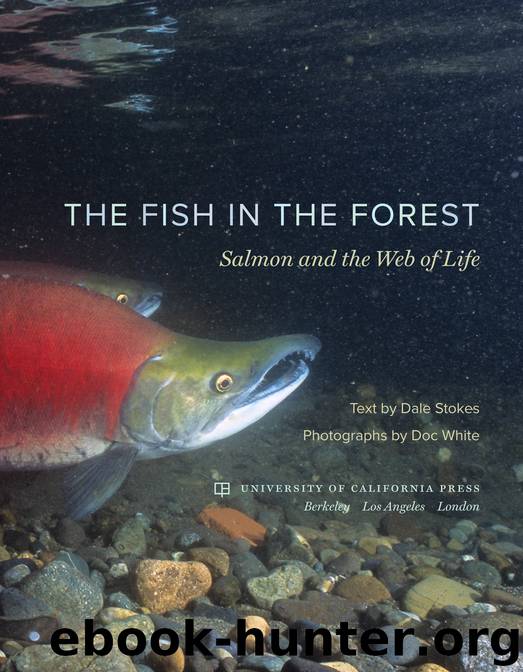
The Fish in the Forest by Dale Stokes
Author:Dale Stokes
Language: eng
Format: epub
ISBN: 9780520269200
Publisher: University of California Press
SALMON GESTALT
TO A BIOLOGIST, describing a salmon’s gestalt is actually a question of accurately defining the salmon’s niche. The term niche implies more to a scientist than the common notions of a niche as being something’s particularly suitable position in the idiomatic grand scheme of things. In scientific parlance, a salmon’s niche can have quantifiable characteristics, and it is an ecological construct of subtle meaning that was debated for decades. Informal thoughts of an organism’s niche had been considered for many years, but this important biological concept wasn’t unequivocally stated until about 1920, by the zoologist Joseph Grinnell. To Grinnell, a niche was an idealized concept of physical space; it was an indication of a geographical distribution with limits, restricted by physical or climatic barriers that were particular to different species. The salmon’s physical world is restricted to the freshwaters of the coastal forests, as well as the pelagic Pacific Ocean. On a finer scale, you can place further limits on this potentially enormous environmental space by considering other variables, like a salmon’s requirements for water of a specific temperature, or amount of dissolved oxygen, or salinity. The niche can be further refined by including seasonal changes in distribution, or time of day, or the variation in distribution of different life history stages. The physical niche of an alevin is much different from that of a smolt or an adult, and all these “niche spaces” would be distinct for different salmon species.
Around the same time that this spatial conceptualization of an organism’s niche was being developed, the biologist Charles Elton proposed a niche concept that implied functionality: the role that an organism plays in its community, and most important, its place as either predator or prey (i.e., its trophic status). A more subtle distinction within the niche concept is that Elton’s niche represented an actual place in an ecosystem due to organism interaction, as opposed to the potential physical place in a landscape inherent in Grinnell’s. This functional niche is still fluid and changes over an organism’s life history; an alevin, hidden in the gravel and feeding off its yolk, has a different role in the Salmon Forest than does a planktivorous smolt in an estuary, or an adult salmon at sea feeding on squid or being snatched from a stream by a bear.
In 1932, the Russian ecologist Georgii Gause used the functional niche concept as a key component in formulating the competitive exclusion principle, which became an important axiom of modern ecology. In an elegant way, the principle states that if the characteristics defining the niche of two species are similar, the two species cannot coexist. This apparently simple axiom synthesizes the competition for limited environmental resources between populations of different species, the evolutionary powers of natural selection, with the idea of a niche as a functional unit. Should there be two or more species competing for the same resources, like food or space, whichever species has even the slimmest competitive advantage will eventually prevail over the others. Only
Download
This site does not store any files on its server. We only index and link to content provided by other sites. Please contact the content providers to delete copyright contents if any and email us, we'll remove relevant links or contents immediately.
The Lonely City by Olivia Laing(4801)
Animal Frequency by Melissa Alvarez(4470)
All Creatures Great and Small by James Herriot(4319)
Walking by Henry David Thoreau(3959)
Exit West by Mohsin Hamid(3826)
Origin Story: A Big History of Everything by David Christian(3692)
COSMOS by Carl Sagan(3623)
How to Read Water: Clues and Patterns from Puddles to the Sea (Natural Navigation) by Tristan Gooley(3467)
Hedgerow by John Wright(3360)
How to Read Nature by Tristan Gooley(3341)
The Inner Life of Animals by Peter Wohlleben(3318)
How to Do Nothing by Jenny Odell(3302)
Project Animal Farm: An Accidental Journey into the Secret World of Farming and the Truth About Our Food by Sonia Faruqi(3221)
Origin Story by David Christian(3201)
Water by Ian Miller(3184)
A Forest Journey by John Perlin(3073)
The Plant Messiah by Carlos Magdalena(2934)
A Wilder Time by William E. Glassley(2862)
Forests: A Very Short Introduction by Jaboury Ghazoul(2842)
